Loan Precision Engine
Most online calculators give you an idealized monthly payment that ignores banking rules, tax reserves, and cash timing. We built a month-by-month underwriting simulator around real Czech state guarantee constraints—showing what happens when grace periods expire, clients pay late, and math has to survive banker review.
Actuarial Architecture & Calculation Pipeline
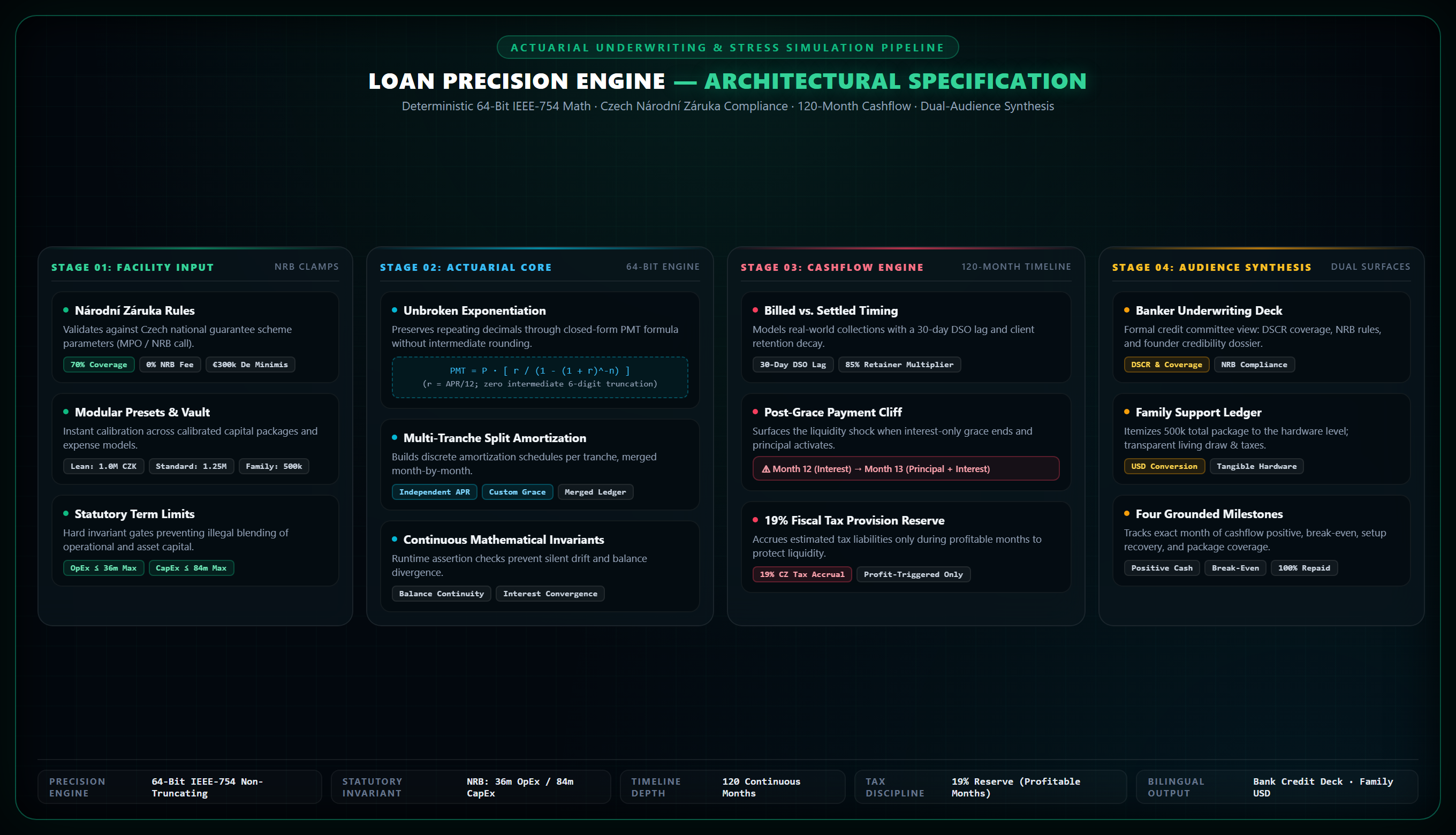
Actuarial calculation pipeline: from tranche configuration and statutory NRB validation to 120-month cashflow simulation and dual-audience synthesis (Banker vs. Family). Click to expand.
Interactive Workspace
Open Working Calculator
(Scenario Vault, Mixing Desk & Stress Model)
The live financial simulator remains active at its original route so founders and reviewers can test split tranches, swap expense modules, and inspect 120-month cashflow.
Toggle between Lean Launch (1.0M CZK), Standard Build (1.25M CZK), and Family Support presets, review DSCR coverage, and inspect the post-grace payment cliff in real time.
Full 64-bit precision with discrete OpEx and CapEx amortization schedules and zero external analytics tracking.
Separate schedules for operating cash and assets
Under Czech Národní záruka rules, operating expenses cannot exceed a 36-month guarantee, while capital investments can run up to 84 months. The engine splits the loan into independent schedules with separate grace periods, interest rates, and payoff horizons rather than blending them into an illegal single note.
Holding repeating decimals until the formula finishes
Many spreadsheets and online calculators chop repeating monthly interest decimals down to 6 or 8 digits mid-calculation. Over 5 years of compound interest, that premature rounding destroys pennies. We hold uninterrupted 64-bit precision through every monthly power calculation so the schedule matches actuarial reality.
Preparing for the Month 13 debt service shock
During an interest-only grace period, monthly debt service looks deceptively affordable. When principal payments start in Month 13, monthly debt service jumps sharply. The engine highlights this cash cliff visually so founders and lenders see the liquidity shock before signing.
Actuarial Reality vs. Software Illusions
Why Financial Modeling Demands First-Principles Precision
In financial modeling, quiet inaccuracy is worse than a hard error.
In normal web development, when code fails, it crashes. The page goes blank or throws an error, and someone fixes it. But financial calculators almost never crash. They keep running smoothly, drawing clean charts and rendering polished tables, even while accumulating rounding drift, mismatched grace periods, or unhandled tax liabilities.
When an early test version of our engine returned monthly payments that were 2 CZK different from generic banking websites, our automated test suite flagged our code as broken. But when we audited the math, our code was right: the online tools were quietly truncating decimals mid-formula. A tool used to evaluate a 1,000,000 CZK loan cannot afford silent drift. Rigorous unit testing and invariant assertions are not hidden background chores here—they are the primary safety mechanism.
One verified math engine serving two radically different audiences.
Securing early funding often involves two completely different conversations: a formal credit review with a commercial bank underwriter, and an honest conversation with family supporters. Most founders either try to force complex banking spreadsheets on their family, or use vague estimates that fail under bank scrutiny.
The engine solves this by driving two separate presentation surfaces from the same underlying ledger. The Bank Assessment modal speaks in debt-service coverage ratios (DSCR), fixed-charge coverage, and state guarantee compliance. The Family Summary strips away banking jargon, itemizes tangible purchases down to the hardware level, shows minimum living draws, and answers the four questions family actually care about: when does monthly cashflow turn positive, when is break-even reached, when are startup costs recovered, and when is their support fully covered.
Actuarial & System Mechanics
Six Invariant Engines Under the Hood
Built and verified in Prague to test real business financing under Czech national guarantee rules. The engine combines closed-form PMT mathematics with multi-tranche constraints and 120 months of dynamic cashflow modeling.
Legal Term Enforcement
Enforces hard legal boundaries between 36-month working capital and 84-month investment tranches under Czech Národní záruka regulations.
Unbroken Exponentiation
Evaluates closed-form PMT annuity formulas without intermediate rounding, preserving repeating monthly fractions through full compound calculations.
Collection Lag Realism
Distinguishes invoiced revenue from bank account cash by modeling a 30-day collection lag alongside retainer retention decay rates.
Profitable-Month Tax Accrual
Accrues estimated tax liabilities only during profitable months, preventing paper profits from masking upcoming annual tax payment obligations.
Month 13 Step-Change Warning
Monitors the sharp increase in monthly debt service between Month 12 (interest-only) and Month 13 (principal + interest) to prevent cash shortfalls.
Bilingual Output Surfaces
Generates formal credit committee underwriting decks alongside clear, itemized family support summaries with presentation-level USD conversion.
Where earlier versions fell short and what we learned.
We test financial systems under realistic underwriting conditions. When an assumption drifts or breaks against regulatory rules, we document exactly why and rebuild the architecture.
The Verification Fallacy
Why benchmarking against existing industry tools reproduces errors
We initially validated our calculation engine by comparing its monthly payment outputs against popular online banking calculators and generic spreadsheet formulas.
Our automated test suite flagged our engine as broken because our output was exactly 1–2 CZK different. But when we audited the mathematical breakdown, our engine was right: the online tools were quietly truncating repeating monthly decimals (like 5.5% / 12) at 6 or 8 digits mid-calculation, destroying pennies over 60 compounded months.
We learned never to assume an existing tool is ground truth just because it ranks first on Google. True verification requires testing against first-principles actuarial mathematics, holding uninterrupted 64-bit precision through the entire formula evaluation.
The Silent Run-Time Drift
Why mathematical inaccuracy in underwriting is far worse than a crash
Standard software engineering assumes that if an application has a bug, the code will fail loudly—throwing an error, breaking the build, or crashing the route.
Financial calculators almost never crash. They render clean tables, draw smooth SVG charts, and display confident numbers even while accumulating compound interest skew, rounding drift, or unhandled tax liabilities month after month.
In loan underwriting, quiet inaccuracy is vastly more dangerous than broken code. We established continuous runtime invariant assertions across balance continuity, interest convergence, and statutory term caps to guarantee the numbers never drift.
The Grace Period Illusion
How smoothing payment schedules conceals the Month 13 liquidity shock
Early users wanted a single average monthly payment figure across the life of the loan to simplify their cashflow projections.
During an initial 12-month grace period, borrowers pay only interest. If they budget based on a smoothed average, Month 13 arrives as an abrupt liquidity shock when principal amortization begins, triggering immediate cash shortfalls.
We banned smoothed payment averages. The engine explicitly models the interest-only phase and highlights the Month 13 debt service step-change with dedicated visual warning bars, forcing operators to verify cash reserves before signing.
The Single-Note Trap
Why treating startup capital as a single loan triggers credit rejection
In our earliest prototype, we modeled startup funding as a single consolidated loan facility with one term and one interest rate.
When reviewed against Czech Národní záruka regulations, we discovered that commercial credit committees will reject a facility immediately if operating working capital is blended into an asset loan running longer than 36 months.
We re-architected the model from the ground up to enforce statutory split tranches. The engine isolates operating expenses (36-month cap) from capital equipment (84-month cap), running discrete amortization schedules that merge month-by-month into a legally compliant master ledger.
Financial Logic & Systems Advisory
Built for founders navigating high-stakes financing.
The Loan Precision Engine is available as an elevated proof-of-work in Labs, with full working mathematical models and scenario tools running in production. If your business needs actuarial rigor, custom financial planning engines, or deterministic decision pipelines, we build tools that survive bank review.